Home
>
Blog
>
Modern LMS for Employee Training
Employee training is no longer optional. Businesses that invest in modern
learning management systems gain better compliance tracking, faster onboarding,
improved employee engagement, and scalable training delivery across their organization.
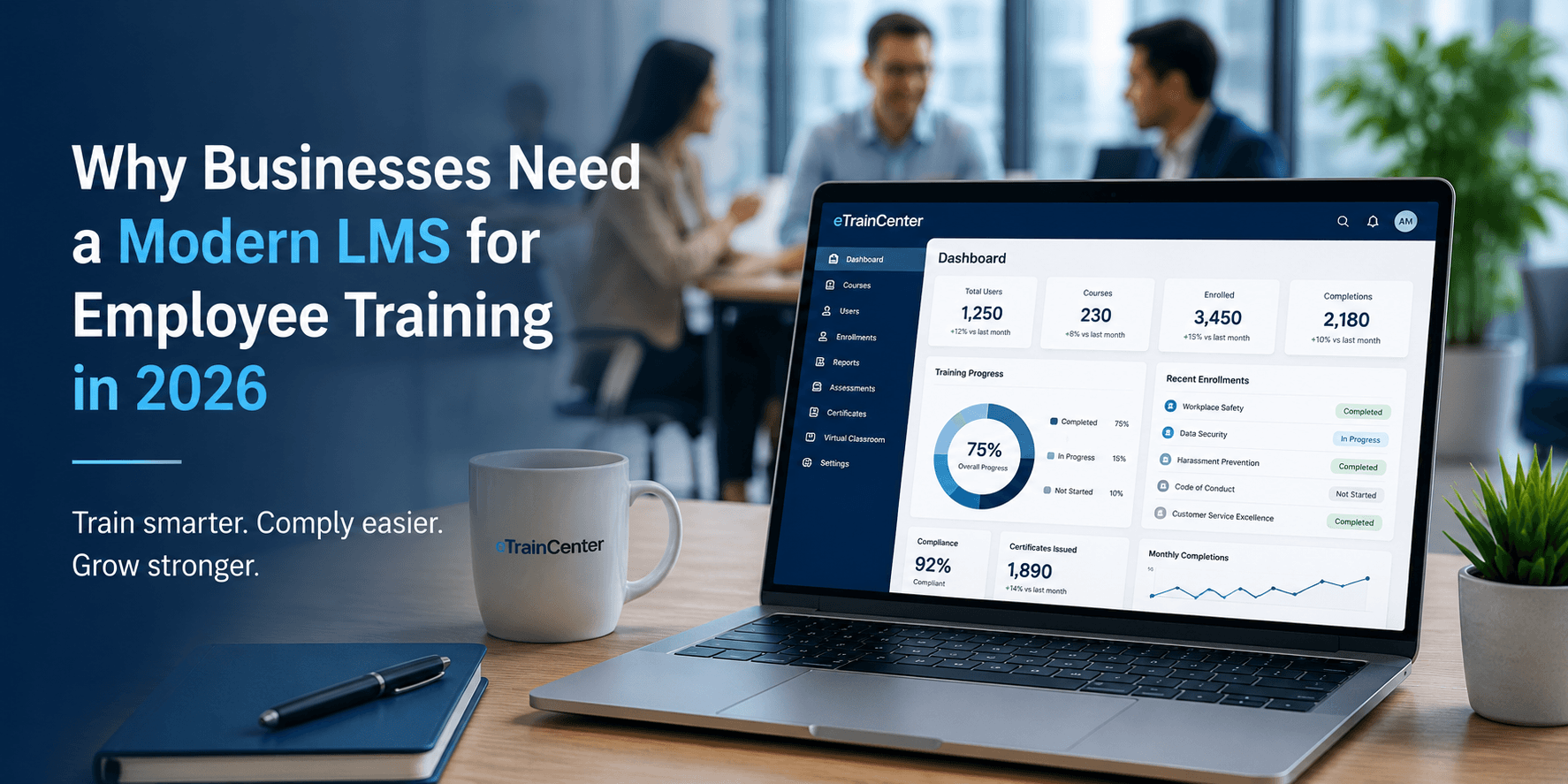
The way companies train employees has changed dramatically over the last few years.
Remote work, hybrid teams, compliance requirements, and rapid technology changes
have forced businesses to rethink how they deliver learning and development programs.
Traditional classroom-only training is no longer enough. Organizations now need
scalable, flexible, and measurable training solutions that work across multiple
locations, devices, and learning styles.
This is why more companies are investing in modern Learning Management Systems (LMS)
to centralize and automate employee training.
What Is a Learning Management System (LMS)?
A Learning Management System is a software platform used to create, manage,
deliver, and track training programs online.
An LMS allows businesses to:
- Deliver online courses and assessments
- Track learner progress and certifications
- Manage compliance training
- Conduct virtual instructor-led training
- Automate onboarding programs
- Generate reports and analytics
- Support remote and hybrid learning
A modern LMS helps businesses reduce administrative work while improving
employee training consistency and accountability.
Why Companies Are Moving to Online Training Platforms
1. Scalability
Training employees across multiple offices or remote locations can be difficult
and expensive using traditional methods.
An LMS allows organizations to train hundreds or thousands of employees
consistently from a single platform.
Cloud-based LMS platforms also reduce travel costs, printed materials,
scheduling conflicts, and instructor overhead.
2. Better Compliance Management
Compliance training is one of the biggest reasons organizations implement an LMS.
Industries such as healthcare, manufacturing, finance, and construction often
require recurring certifications and mandatory training.
A Compliance Training LMS helps businesses:
- Assign required courses automatically
- Track completion dates
- Maintain audit-ready records
- Generate compliance reports
- Send automated renewal reminders
3. Improved Employee Engagement
Modern learners expect interactive and flexible training experiences.
Effective LMS platforms support:
- Video-based learning
- Interactive quizzes and assessments
- Gamification features
- Mobile learning
- Self-paced learning paths
- Virtual classrooms
User-friendly LMS platforms improve course completion rates and learner engagement
while giving employees more flexibility in how and when they learn.
4. Faster Employee Onboarding
A structured onboarding program helps new employees become productive faster.
Using an LMS, companies can automate onboarding by assigning:
- Welcome courses
- HR documentation
- Compliance training
- Role-specific learning paths
- Systems and product training
This creates a more consistent onboarding experience while reducing the workload
on HR teams and managers.
5. Centralized Training Management
Without an LMS, training materials are often scattered across emails,
shared drives, spreadsheets, and disconnected software tools.
A centralized LMS provides one secure location for:
- Training content
- Learner records
- Reporting and analytics
- Certifications
- Virtual sessions
- Course management
Key Features Businesses Should Look for in an LMS
When evaluating an LMS platform, organizations should focus on features
that support both current and future training needs.
- SCORM compliance
- Mobile-friendly learning
- Virtual classroom integration
- Reporting and analytics
- Certification management
- eCommerce functionality
- Multi-language support
- Role-based permissions
- Learning paths
- Assessment and survey tools
- API and SSO integrations
Final Thoughts
Employee training is no longer optional. Businesses that invest in learning
and development are better positioned to improve productivity, maintain compliance,
reduce turnover, and adapt to industry changes.
A modern LMS gives organizations the tools to deliver effective, scalable,
and measurable training programs while creating better learning experiences
for employees and customers alike.
Looking for a Modern LMS?
eTrainCenter provides businesses with a powerful Learning Management System
for corporate training, compliance management, certifications, assessments,
virtual learning, and employee onboarding.
Request a Demo


